
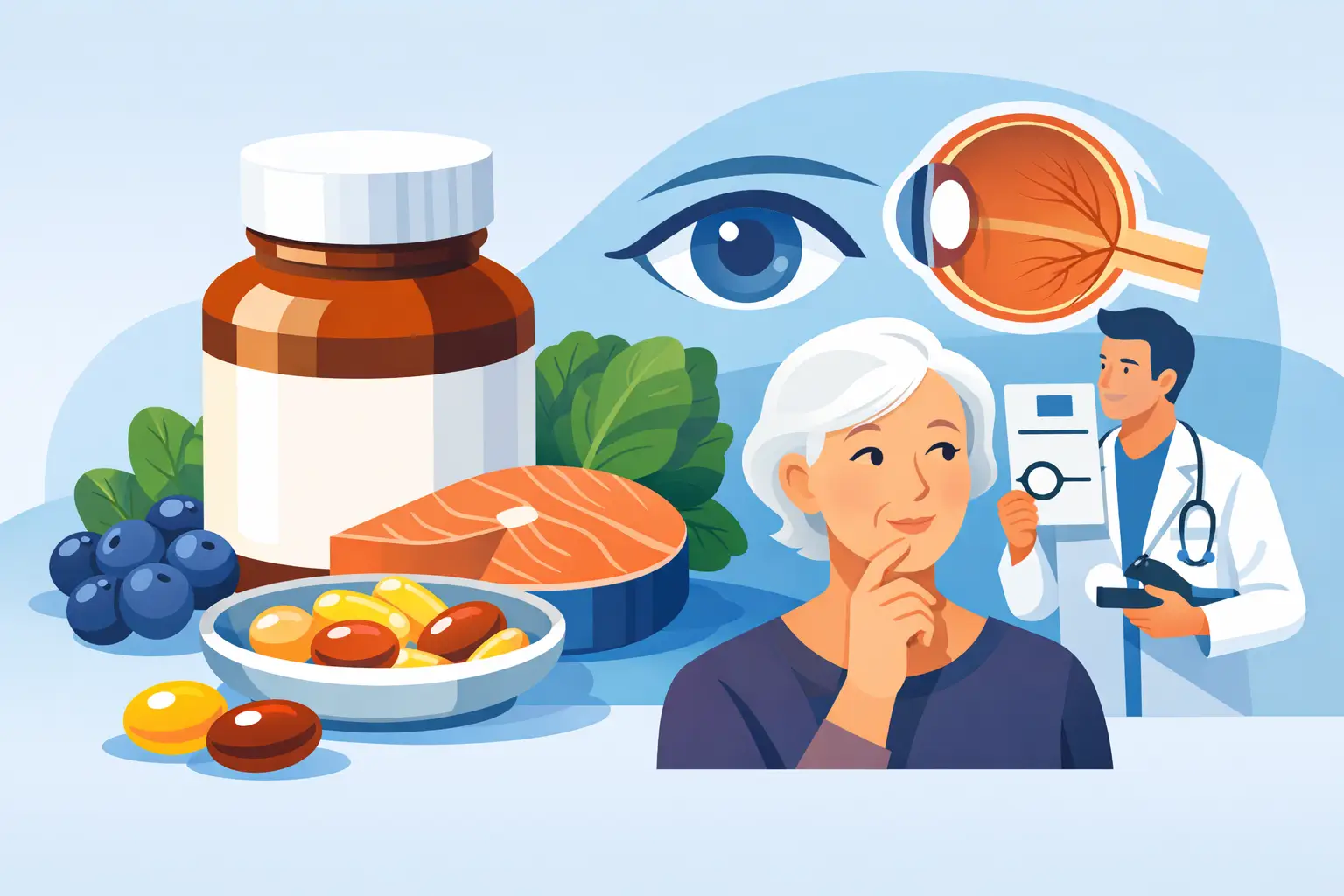
An AREDS 2 supplement is often recommended after an eye examination identifies a particular stage of age-related macular degeneration, commonly called AMD. It is not a general eye vitamin, and it is not the right choice for every person who notices blurred vision or has a family history of macular disease. The value lies in matching the supplement to the right diagnosis, then monitoring eye health carefully over time.
AMD affects the macula, the small central part of the retina responsible for detailed vision. This is the vision used for reading, recognising faces, seeing road signs and many close tasks. As AMD progresses, central vision can become distorted, blurred or patchy, while side vision usually remains intact.
What an AREDS 2 supplement is designed to do
AREDS stands for Age-Related Eye Disease Study. Large clinical studies found that a specific combination of antioxidant vitamins and minerals could reduce the risk of progression to advanced AMD in people with intermediate AMD, or advanced AMD in one eye.
The important word is progression. AREDS 2 supplements do not cure AMD, restore vision already lost from the condition, or prevent everyone from developing macular degeneration. They are intended to lower the risk of a more severe stage of disease in people who meet particular clinical criteria.
That is why choosing a supplement based on advertising, a friend’s recommendation or a family history alone can be misleading. An optometrist or ophthalmologist needs to assess the macula and determine whether the supplement is likely to offer a meaningful benefit.
Who may benefit from AREDS 2 supplements?
AREDS 2 is generally considered for people with intermediate AMD in one or both eyes, or for those who have advanced AMD in one eye and are at risk in the other. Intermediate AMD may involve larger deposits beneath the retina, known as drusen, or changes in retinal pigment seen during a detailed examination and retinal imaging.
People with early AMD do not necessarily benefit from the formula. In this stage, regular monitoring, a healthy lifestyle and knowing which symptoms need urgent assessment may be more appropriate. People without AMD should not assume that taking AREDS 2 will protect their eyes from future disease.
The distinction matters because central vision changes have many possible causes. Cataracts, dry eye, prescription changes, diabetic eye disease and retinal conditions can all affect sight. A supplement cannot replace a comprehensive eye examination.
A family history is a reason for checks, not automatic treatment
AMD can run in families, so it is sensible to let your eye care provider know if a parent or sibling has had macular degeneration. This information can guide how closely your macula is monitored. However, family history by itself does not mean an AREDS 2 formula is needed.
Regular examinations can identify early changes before you notice symptoms. For many people, this is the most useful first step.
What is in the AREDS 2 formula?
While product labels vary, the studied AREDS 2 formula typically includes vitamin C, vitamin E, zinc, copper, lutein and zeaxanthin. Lutein and zeaxanthin are carotenoids found naturally in the macula and in foods such as leafy green vegetables, corn and eggs.
Zinc is included at a relatively high dose in the original formulation, which is one reason it is worth discussing the product with a health professional rather than treating it like an ordinary multivitamin. Copper is added because long-term zinc supplementation can reduce copper levels in the body.
The original AREDS formula contained beta-carotene. AREDS 2 replaced beta-carotene with lutein and zeaxanthin. This is particularly relevant for people who smoke or used to smoke, as beta-carotene supplementation has been associated with an increased risk of lung cancer in these groups. Check the label carefully: an eye supplement is not necessarily an AREDS 2 supplement simply because it contains lutein.
Why the right product and dose matter
There are many eye-health products on pharmacy shelves. Some contain only lutein, others have lower amounts of the AREDS ingredients, and some combine a broad range of vitamins in doses that have not been studied for AMD progression. These products may have a place for some individuals, but they should not be assumed to provide the same evidence-based benefit as the AREDS 2 formulation.
An exact match is not always straightforward either. Different brands may use a lower zinc dose or present nutrients in slightly different forms. A lower-zinc formulation may be considered where tolerance or other health factors are a concern, but the decision should be personalised.
Bring the bottle, a photo of the label, or a list of your current supplements to your appointment. It is surprisingly easy to double up on vitamin E, zinc or other nutrients when taking a multivitamin alongside an eye formula.
AREDS 2 is not suitable for everyone without advice
Although AREDS 2 products are available without a prescription, they can still matter clinically. High-dose supplements may cause side effects such as stomach upset or constipation in some people. They may also be relevant if you take blood-thinning medicines, have kidney concerns, are managing other chronic health conditions, or already use several supplements.
Your GP, pharmacist and eye care provider can help check for potential interactions and decide whether the formulation fits your overall health needs. Do not stop prescribed medicine in favour of a supplement, and do not increase the recommended dose in the hope of getting extra protection.
For patients taking AREDS 2, it is also useful to tell every member of your health care team. Coordinated care is especially helpful when eye disease sits alongside diabetes, cardiovascular disease or multiple medications.
Eye checks remain the centre of AMD care
Supplements are only one part of looking after macular health. AMD can change gradually, but some forms can worsen quickly. New distortion in straight lines, a dark or missing patch in central vision, sudden difficulty reading, or a noticeable drop in vision should be assessed urgently, preferably on the same day.
At home, checking each eye separately can help you notice a new difference. Look at a familiar straight-edged object, such as window blinds or tiles, in good light. If lines appear wavy, broken or distorted in one eye, do not wait for your next routine appointment.
Comprehensive eye examinations may include a close retinal assessment and imaging to document changes at the macula. Comparing images over time helps your optometrist identify whether AMD is stable or whether referral to an ophthalmologist is needed. If wet AMD is suspected, prompt treatment can be vision-saving.
Everyday habits still make a difference
No supplement can compensate for smoking. Stopping smoking is one of the most meaningful actions a person can take to reduce their AMD risk. A diet rich in colourful vegetables, fruit, fish and healthy fats supports general and eye health, while managing blood pressure and maintaining regular physical activity also matter.
Sunglasses that provide good UV protection are sensible for outdoor comfort and eye protection, although they are not a substitute for monitoring AMD. If you have been prescribed an AREDS 2 formula, take it as directed and continue these wider health habits.
A practical next step for your vision
If you have been told you have drusen, early macular changes or AMD, arrange an eye examination before selecting an AREDS 2 supplement. At Boda Family Eye Care, we can assess your retinal health, explain what your findings mean in plain language and advise when monitoring, supplementation or specialist referral is appropriate.
The most reassuring approach is a clear plan that fits your own eyes: know your diagnosis, understand any recommended supplement, and seek help promptly if your vision changes.