
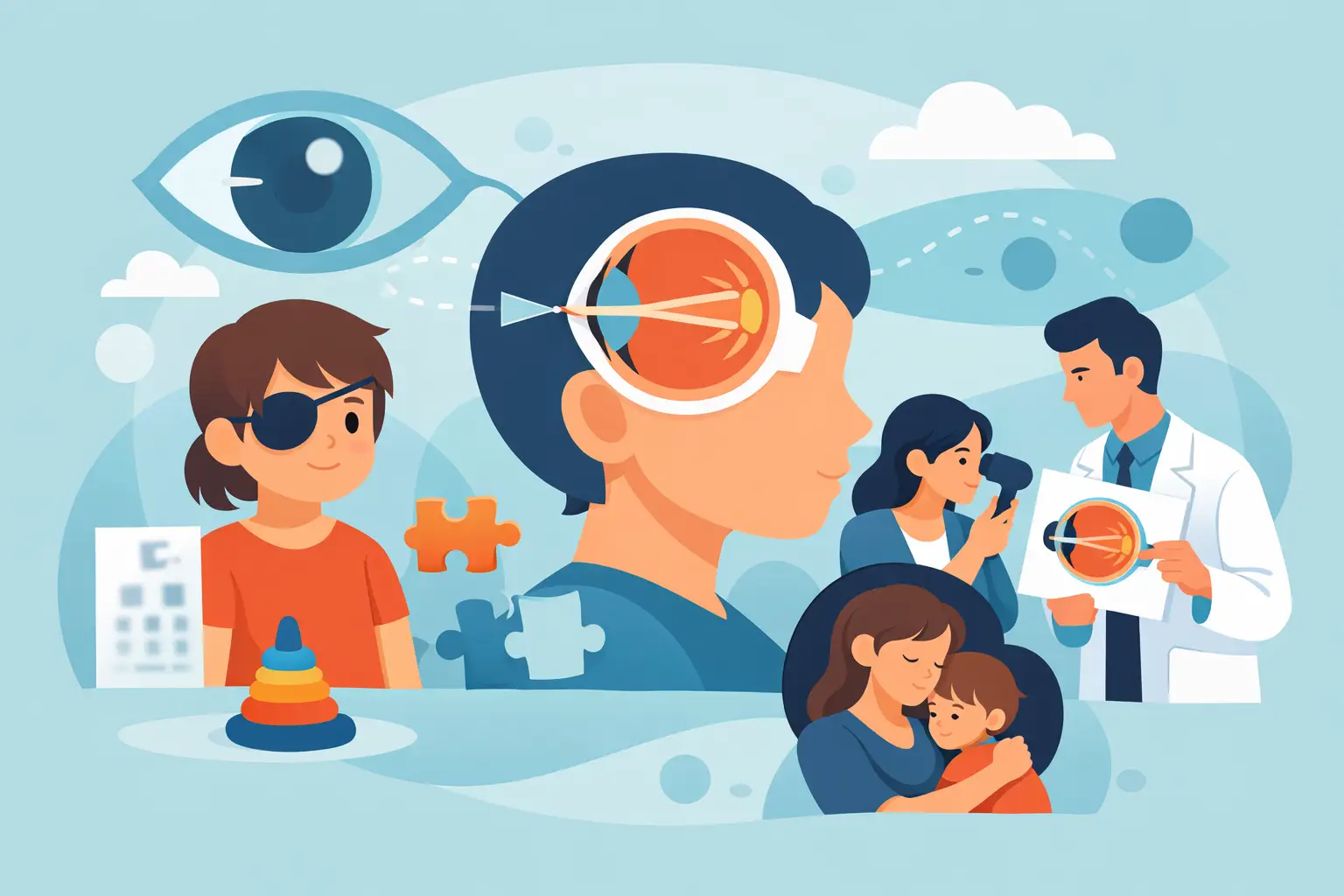
A child may appear to see perfectly well while one eye is doing far less work than the other. They may recognise faces, watch television and play normally, yet their brain may be relying heavily on their stronger eye. This is why amblyopia, often called a lazy eye, can be difficult for parents to spot without a thorough eye examination.
Amblyopia is one of the most common causes of reduced vision in children. The good news is that it can often be treated effectively, particularly when it is found early. Prompt assessment gives the visual system the best opportunity to develop well and helps protect a child’s vision for the years ahead.
What is amblyopia?
Amblyopia occurs when vision does not develop normally in one eye, and occasionally both eyes, during early childhood. The eye itself may look healthy, but the brain has learned to favour clearer information from the stronger eye. Over time, it pays less attention to the blurrier image.
This is not a matter of a child being unwilling to use one eye. It is a developmental vision condition involving the connection between the eye and the brain. Without treatment, the reduced vision may become harder to improve as a child grows older.
The term “lazy eye” is commonly used, but it can be misleading. Sometimes an eye turn is visible, but many children with amblyopia have eyes that look straight and healthy. A child may not realise that their vision differs between eyes because they have never known anything else.
What causes amblyopia in children?
Amblyopia has several causes. Identifying the cause matters because treatment is tailored to the child’s specific vision needs.
Different prescriptions in each eye
A significant difference in long-sightedness, short-sightedness or astigmatism between the eyes can cause amblyopia. The brain naturally chooses the clearer image and begins to ignore the blurred one. This is called refractive amblyopia and is easy to miss, as there may be no obvious eye turn or complaint from the child.
In some children, both eyes have a high uncorrected prescription. If both images are consistently blurred during the important early years of visual development, vision may not develop as clearly as it should.
An eye turn
When one eye turns in, out, up or down, the brain receives two images that do not line up. To avoid double vision or confusion, it may suppress the image from the turned eye. This is known as strabismic amblyopia.
An eye turn can be constant or occasional. It may be more noticeable when a child is tired, unwell or focusing on something close. Any persistent or recurring eye turn should be assessed, even if it seems mild.
A blockage of clear vision
Less commonly, something physically blocks light from entering the eye properly. Examples include a congenital cataract, a droopy eyelid that covers the pupil, or a problem affecting the front of the eye. This form of amblyopia requires urgent assessment, as early treatment is particularly time-sensitive.
Signs parents may notice
Children are remarkably adaptable, so amblyopia often has no clear symptoms. They may simply use their stronger eye and continue with everyday activities. That is why regular children’s eye examinations are valuable, especially before school starts.
Some signs that may warrant an appointment include frequent squinting, closing or covering one eye, sitting very close to screens or books, rubbing the eyes, headaches, or losing their place while reading. A child may tilt their head, become frustrated with detailed tasks, or have trouble catching a ball and judging distances.
An eye that appears to wander, turn or move differently from the other eye should always be checked. So should concerns raised by a teacher, GP, child health nurse or family member.
It is also worth remembering that passing a basic vision screening does not rule out every eye health or visual development issue. A comprehensive examination checks more than whether a child can read letters on a chart.
How amblyopia is diagnosed
A children’s eye examination is designed to be calm, age-appropriate and practical. Depending on a child’s age, vision can be measured using pictures, matching games, letters or other simple activities. Children do not need to be able to read to have their eyes assessed.
An optometrist will assess how clearly each eye sees, how the eyes work together, eye alignment, focusing ability and the health of the eyes. Special tests can determine whether glasses are needed and whether the prescription differs between the eyes.
For younger children, the examination also considers visual behaviour. How a child fixes and follows a target, responds when one eye is covered and uses their eyes together can provide important information.
If an eye condition requires medical or surgical care, coordinated referral to an ophthalmologist may be recommended. This collaborative approach helps ensure children receive the right care at the right time.
Amblyopia treatment: why early action matters
Treatment aims to give the brain a clear image from the affected eye and encourage it to use that eye more effectively. The earlier treatment begins, the more adaptable a child’s visual system is likely to be. However, children of different ages can still benefit from assessment and treatment, so it is never a reason to delay seeking advice.
For many children, correctly prescribed glasses are the first and most important step. Wearing glasses consistently can improve the clarity of the image reaching the weaker eye. In some cases, glasses alone produce a substantial improvement over time.
If further treatment is needed, an optometrist or ophthalmologist may recommend patching the stronger eye for prescribed periods. This encourages the brain to use the weaker eye. Atropine eye drops may be used in selected cases to blur vision in the stronger eye temporarily, under professional guidance.
Patching can be challenging for children and parents. A child may initially resist because their weaker eye does not see as well. Clear routines, encouragement and a patch worn during a favourite activity can help. The key is to follow the prescribed schedule rather than making changes independently. Too much or too little patching may not give the desired result.
Treatment plans vary. They depend on the child’s age, vision level, cause of amblyopia, eye alignment and response to glasses or patching. Regular review appointments are essential because vision can improve gradually, and the plan may need adjusting along the way.
Does screen time cause amblyopia?
Screen time does not directly cause amblyopia. Amblyopia is usually linked to an eye turn, an uncorrected focusing problem or a blockage to clear vision. However, excessive close work and screen use can contribute to eye strain, and it may make it easier to notice that a child holds devices unusually close or struggles with visual tasks.
Healthy visual habits still matter. Encourage regular breaks from close work, outdoor time, good lighting and an appropriate viewing distance. Most importantly, do not assume screen habits explain away a concern about your child’s sight.
When should your child have an eye examination?
A child should have an eye examination if you notice an eye turn, unusual visual behaviour or concerns about learning, reading or coordination. Children with a family history of eye turns, strong prescriptions, childhood cataracts or amblyopia should also be assessed early.
Seek prompt medical attention if your child develops a sudden eye turn, has eye pain, significant redness, sensitivity to light, a white or cloudy appearance in the pupil, or a sudden change in vision. These signs are not typical of simple amblyopia and need timely investigation.
For families in Auburn and surrounding Western Sydney suburbs, Boda Family Eye Care provides comprehensive children’s eye examinations with clear explanations at every stage. We can assess your child’s vision, discuss any findings in straightforward language and recommend the appropriate next steps.
A child does not need to be able to describe a problem before their eyes deserve attention. If something seems different, or you simply want confidence that their vision is developing well, a thorough eye examination can provide reassurance and a practical plan for their care.