
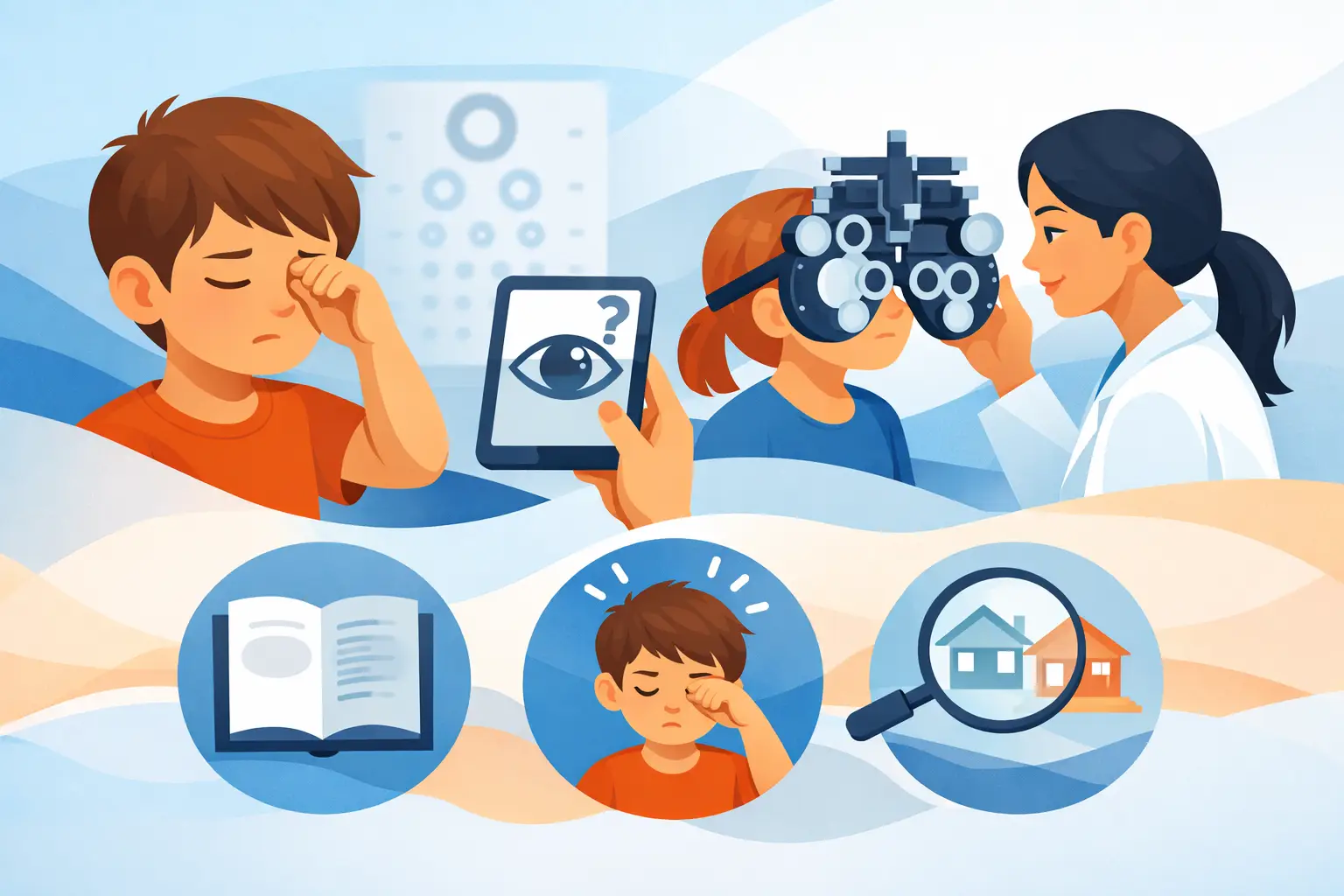
A child can pass a basic school vision screen and still be working far too hard to see comfortably. They may read well but lose their place, avoid close work, sit very close to a screen or complain that their eyes hurt after school. A children’s vision assessment looks beyond whether letters appear clear on a chart. It helps identify how your child’s eyes focus, work together and respond to the visual demands of learning and play.
For parents in Auburn and surrounding Western Sydney suburbs, an eye examination can provide clarity when a child’s behaviour, confidence or classroom performance has changed. Many vision concerns are subtle, and children often assume that the way they see is normal.
Why children’s vision needs more than a school screen
School-based vision checks can be helpful, particularly for identifying some distance vision concerns. However, they are not a full eye examination and may not assess every part of visual function. A child may see the board clearly yet have difficulty maintaining focus when reading, coordinating both eyes, tracking words across a page or judging distance during sport.
A comprehensive assessment also considers eye health. While serious eye conditions in children are less common, early detection matters. The earlier a concern is recognised, the more options there may be to manage it appropriately or arrange referral to an ophthalmologist where needed.
Vision is closely connected with learning, movement and everyday comfort. Reading, handwriting, copying from the board, catching a ball and using digital devices all place different demands on a child’s visual system. If those tasks regularly feel difficult, the child may become tired, frustrated or disengaged without being able to explain why.
Signs your child may need a vision assessment
Children do not always say that their vision is blurry. They may compensate by moving closer, squinting or avoiding activities that make their eyes feel uncomfortable. Changes can be gradual, especially when short-sightedness is developing.
Consider booking an eye examination if your child frequently holds books or devices very close, sits close to the television, squints to see distant objects or complains of headaches and tired eyes. Other signs include rubbing their eyes often, closing or covering one eye, losing their place while reading, skipping lines, poor concentration during close tasks, or a noticeable decline in schoolwork.
It is also worth paying attention to behaviour outside the classroom. A child who struggles to judge steps, avoids ball sports, bumps into objects, tilts their head consistently or reports double vision should be assessed promptly. These signs do not always mean there is a vision problem, but they are good reasons to have their eyes checked rather than simply waiting for the issue to pass.
Family history is another important consideration. If parents or siblings have significant short-sightedness, lazy eye, eye turns, childhood eye disease or strong prescriptions, regular monitoring can be particularly valuable.
What happens during a children’s vision assessment
A children’s eye examination is designed to be age-appropriate, calm and engaging. Younger children do not need to know the alphabet or read tiny letters for an assessment to be useful. Pictures, matching cards and other child-friendly methods can be used to measure vision and understand how each eye is performing.
At Boda Family Eye Care, the examination begins with a conversation about your child’s general health, family eye history, school activities, screen use and any symptoms you have noticed. This context helps the optometrist decide which tests are most relevant. Bringing along your child’s current glasses, if they wear them, is helpful.
The assessment may include checking distance and near vision, how accurately the eyes move and align, whether the eyes focus comfortably, depth perception, colour vision where appropriate, and the health of the front and back of the eye. The optometrist may also measure the prescription in each eye. Some children may need eye drops to allow a more accurate assessment of their focusing system. If drops are recommended, the reason and what to expect will be explained beforehand.
The appointment is not a test your child can fail. It is an opportunity to understand their visual needs. Many children enjoy the interactive nature of the testing when it is explained in simple, reassuring language.
Clear sight is only one part of the picture
A clear prescription does not always mean a child’s vision is comfortable for sustained schoolwork. The eyes must also work together efficiently. For example, if one eye turns slightly in or out, or if the focusing system has trouble adjusting from the board to a workbook, a child may experience fatigue despite having good distance vision.
Equally, not every reading or learning concern is caused by eyesight. Attention, language processing, learning differences, sleep and emotional wellbeing can all play a role. A thorough eye examination can help rule in or rule out visual factors and, where appropriate, support coordinated care with your GP, school or other health professionals.
This is why a comprehensive approach is useful. It avoids assuming that a new pair of glasses is always the answer, while making sure a genuine visual issue is not missed.
Monitoring short-sightedness in growing eyes
Short-sightedness, also called myopia, is becoming more common in children. A child with myopia can usually see close objects clearly but may find the board, street signs or faces at a distance blurry. It often progresses as children grow, so monitoring changes over time is important.
For some children, standard glasses are all that is needed. For others, particularly where myopia is increasing quickly or there is a strong family history, the optometrist may discuss evidence-based myopia management options. The right approach depends on your child’s age, prescription, eye health, lifestyle and ability to use treatment consistently.
Outdoor time is generally beneficial for children’s eye health and overall wellbeing, while regular breaks from sustained close work can improve comfort. These habits are worthwhile, but they do not replace professional monitoring when myopia is present or suspected.
When should children have their eyes checked?
There is no single schedule that suits every child. A first eye check is sensible before school begins, or earlier if you notice symptoms, an eye turn, delayed visual behaviour or a family history of eye concerns. Children already wearing glasses, managing myopia or receiving treatment for an eye condition may need reviews at intervals recommended by their optometrist.
Do not wait for a school report or a complaint of blurred vision if something seems unusual. Children can adapt remarkably well, particularly when one eye sees better than the other. Early assessment can offer reassurance, identify a concern before it affects daily life, and establish a useful baseline for future checks.
Helping your child feel ready for the appointment
Tell your child they are visiting the optometrist to look at how their eyes see and work, much like a check-up for the rest of their body. Avoid presenting the appointment as something to worry about. A well-rested child is often more comfortable and engaged, so choose an appointment time that works around naps, school and other commitments where possible.
Write down any symptoms, when they occur and what seems to trigger them. It can also help to ask teachers whether they have noticed squinting, difficulty copying from the board, reading fatigue or changes in participation. These small observations can give the optometrist a fuller picture than a vision chart alone.
Your child’s vision supports far more than seeing clearly. If you have noticed changes in comfort, confidence or the way they manage visual tasks, a timely eye assessment is a practical next step – and one that can bring valuable peace of mind.