
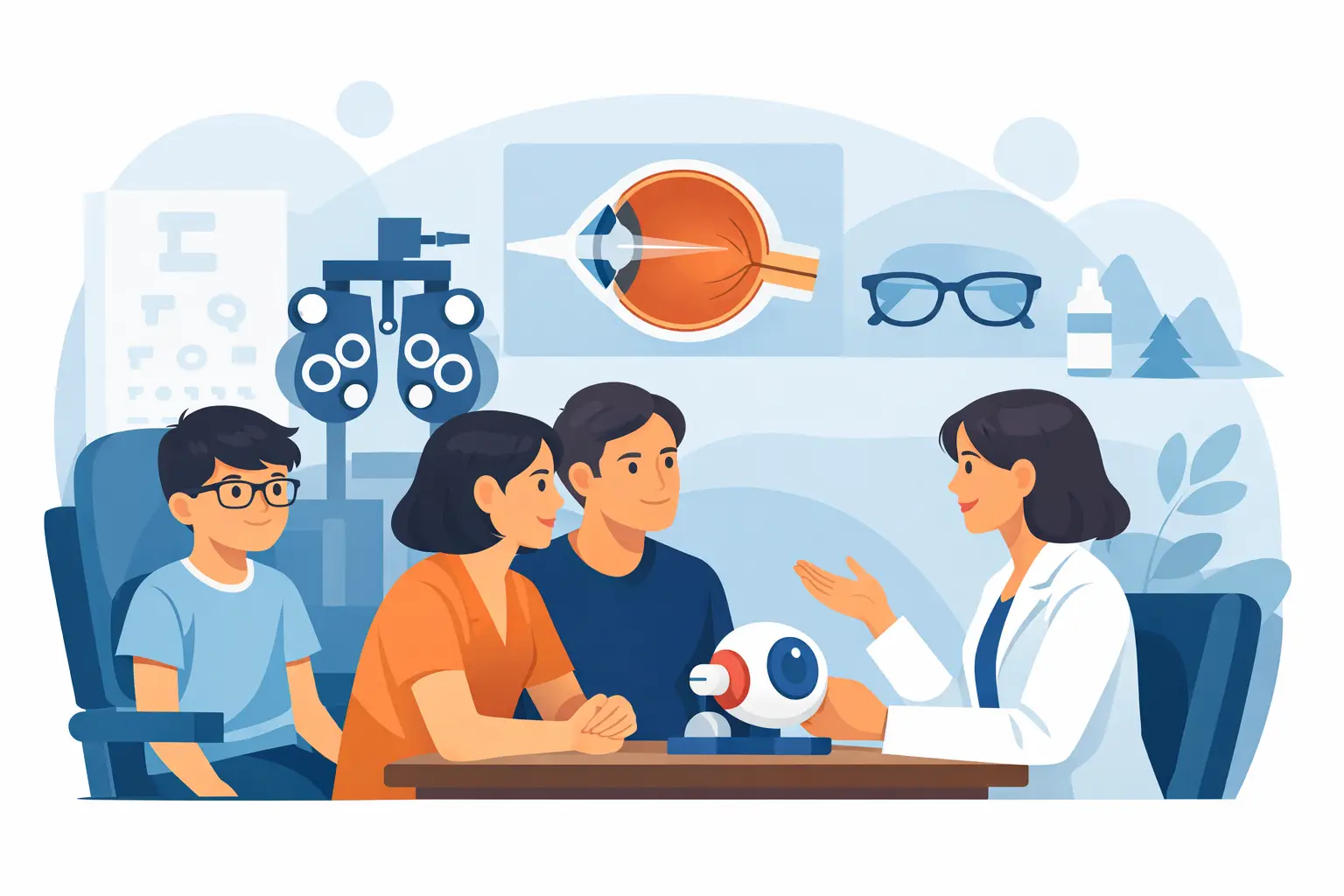
A child may seem to be managing well at school while their distance vision is quietly getting worse. This myopia treatment case study shows why early assessment, a clear management plan and regular reviews can make a meaningful difference for families concerned about short-sightedness.
The example below is a representative clinical scenario, rather than the record of one individual child. Every child’s eyes, prescription, lifestyle and treatment suitability are different, so a comprehensive eye examination is always the starting point.
The concern: distance vision was becoming harder
An eight-year-old child was brought in by her parents after her teacher mentioned that she was moving closer to the whiteboard. At home, she was sitting near the television and occasionally rubbing her eyes after school. Her parents had assumed she simply needed glasses, but they were also worried because both parents were short-sighted.
Myopia, also called short-sightedness, occurs when the eye grows too long or focuses light in front of the retina rather than directly on it. It makes distant objects blurry while close work can remain clear. In children, myopia often progresses as the eyes continue to grow.
A standard vision check can identify that a child needs glasses. A myopia management assessment goes further by considering how quickly the prescription may be changing and whether steps can be taken to slow progression.
Assessment: looking beyond the prescription
The child’s assessment included more than reading letters on a chart. We checked her distance and near vision, measured her prescription, assessed how her eyes worked together and examined the health of the front and back of each eye.
Her prescription confirmed low myopia in both eyes. We also discussed factors that can influence progression. These included a strong family history of myopia, considerable time spent on close tasks and limited outdoor time during the school week. None of these factors guarantees that myopia will worsen quickly, but together they supported a proactive approach.
Where suitable, measuring axial length can add another valuable piece of information. Axial length is the physical length of the eye. Monitoring it over time can help show whether the eye is elongating faster than expected, even before a large prescription change becomes obvious.
Just as importantly, the consultation gave the family space to ask practical questions. Would glasses make the eyes weaker? No. Could screen use be the only cause? Not usually. Screens and prolonged close work may contribute to a child spending less time outdoors or taking fewer visual breaks, but myopia has several influences, including genetics and eye growth.
Myopia treatment case study: choosing a plan
For this child, the aim was twofold: give her clear, comfortable vision now and reduce the likelihood of rapid myopia progression over the coming years. The family chose a personalised plan that combined myopia control spectacle lenses with lifestyle support and scheduled monitoring.
Myopia control spectacle lenses were a practical choice because the child had never worn contact lenses and her parents wanted a simple routine. These lenses correct distance vision while using specialised optical designs intended to help manage eye growth. They are not the same as standard single-vision glasses.
Other options may be appropriate for other children. Depending on age, prescription, eye health, maturity and family preference, a practitioner may discuss specialised soft contact lenses, overnight orthokeratology lenses or low-dose atropine eye drops. Each option has benefits and limitations.
Contact lenses can suit active children and offer an effective management option, but they require careful hygiene and responsible wear. Orthokeratology reshapes the cornea overnight so vision can be clear during the day without glasses, yet it also demands consistent cleaning, follow-up and suitability checks. Atropine drops may be useful in some cases, though they do not correct vision and may need to be combined with glasses or contact lenses.
There is no single best treatment for every child. A plan needs to work in real family life, not just on paper.
Building habits that support treatment
Glasses or other treatment options are only part of myopia care. The child and her parents were encouraged to build a few achievable habits around school, homework and weekend activities.
She began spending more time outdoors after school and on weekends, aiming for regular daylight exposure rather than treating outdoor time as another chore. Her family also introduced brief visual breaks during long periods of reading, homework or device use. Holding books and screens at a comfortable distance, rather than very close to the face, was another useful adjustment.
These changes are not a replacement for prescribed treatment, and they cannot reverse established myopia. However, time outdoors and sensible close-work habits are supported components of a wider myopia management plan.
The family also understood the importance of wearing the prescribed glasses consistently. Children sometimes resist new glasses at first, particularly if they are worried about appearance or sports. In this case, choosing a comfortable, well-fitted frame in a style the child liked made daily wear much easier.
Review appointments: measuring progress, not guessing
At the first follow-up, the child reported clearer vision at school and was wearing her glasses reliably. Her parents had noticed fewer complaints about seeing the board. That was encouraging, but clear vision alone does not tell us whether myopia is progressing.
Regular reviews were planned to check the prescription, vision, eye health and, where available, eye growth measurements. The review interval depends on the child’s age, treatment method and risk factors. Many children with progressing myopia need monitoring more often than a routine annual eye test.
Over the next year, her prescription changed only slightly. While one year cannot predict the future, the result suggested that the plan was appropriate at that stage. If progression had remained fast, the conversation would have shifted to whether a different or combined treatment approach was warranted.
This is a key point for parents: myopia control is an ongoing process. It is not a one-off pair of glasses or a treatment that promises a fixed result. Children grow, school demands change and their eyes can respond differently over time. Monitoring allows the plan to be adjusted before a larger change is missed.
What this means for Western Sydney families
Parents often first notice myopia through small everyday signs: a child squinting at signs, sitting close to the television, avoiding sports because they cannot see clearly at distance, or reporting that the classroom board looks blurry. Some children do not mention any difficulty at all because they assume everyone sees the same way they do.
A family history of myopia is a good reason to arrange regular eye examinations, but it is not the only reason. Children should have their vision assessed if there are concerns from home, school or a health professional. An eye examination can also identify other vision or eye health issues that may affect reading, comfort or visual development.
At Boda Family Eye Care, myopia management discussions are centred on clear explanations and realistic choices. Families can understand what the child’s prescription means, why monitoring matters and which options may fit their circumstances. Medicare and private health cover may help with different parts of care depending on eligibility and fund details, so it is worth asking the team what applies to your appointment.
The question parents should ask
The most useful question is not simply, “Does my child need glasses?” It is, “Is their myopia changing, and do we need a plan to manage it?” Asking early creates more time to monitor patterns, discuss suitable treatment options and support healthy visual habits without panic.
If your child is struggling to see the board, moving closer to screens or has a strong family history of short-sightedness, booking a comprehensive eye examination is a practical next step. Clear answers and regular care can help protect both their day-to-day vision and their long-term eye health.