
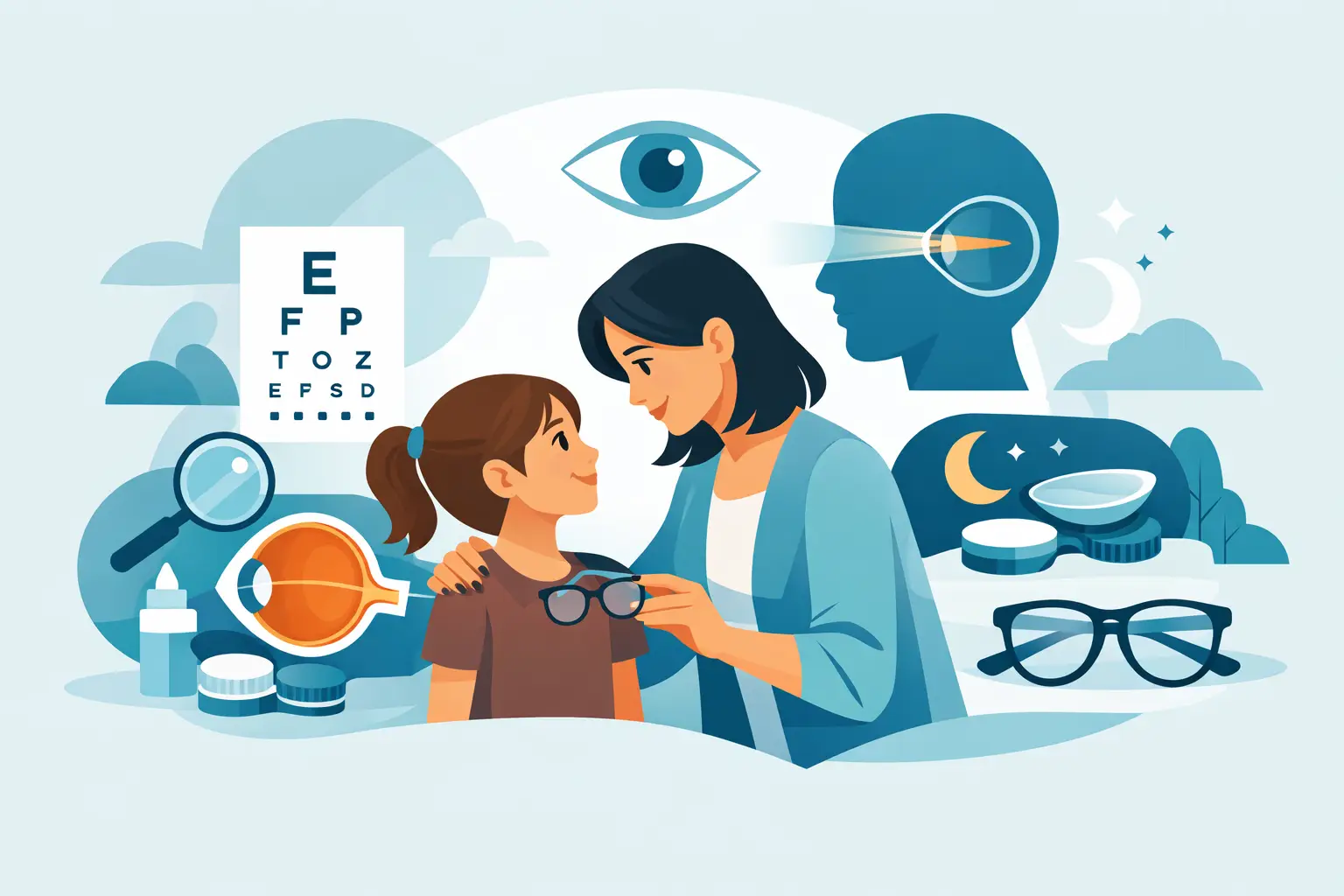
When a child’s glasses prescription keeps changing, it is natural for parents to ask whether anything can slow it down. This guide to myopia management options explains the treatments that may help manage short-sightedness, what is involved in choosing one, and why regular eye care matters beyond simply seeing the classroom board clearly.
Myopia, also known as short-sightedness, means close objects are clearer than those in the distance. It often begins during primary school years and can progress as a child grows. A stronger prescription can be inconvenient, but the bigger concern is that higher levels of myopia are associated with a greater lifetime risk of eye conditions such as retinal problems, glaucoma and myopic macular changes.
Myopia management is not about promising to stop myopia completely. It is about using evidence-based strategies to reduce the rate at which it progresses where appropriate, while monitoring your child’s eye health and vision carefully.
Why a standard eye test is only the starting point
A routine vision check can identify whether a child needs glasses. A myopia management assessment looks more closely at the pattern of prescription change, family history, visual habits and the structure of the eye.
One key measurement is axial length, which is the length of the eyeball from front to back. Myopia commonly progresses as the eye grows longer. Tracking axial length alongside the glasses prescription can give a clearer picture of whether a child’s myopia is stable, changing slowly or progressing faster than expected.
The optometrist will also consider when myopia started. Children who become short-sighted at a younger age may have more years of eye growth ahead of them, so early assessment can be particularly valuable. Having one or both parents with myopia, spending long periods on close work, and limited time outdoors can also influence risk.
Every child is different. The right approach depends on their age, prescription, eye health, lifestyle, maturity and comfort with glasses or contact lenses.
Guide to myopia management options for children
There is no single best option for every family. In many cases, the most suitable treatment is one a child can use consistently and safely, with regular review. Your optometrist can explain the expected benefits, limitations and practical commitments of each approach.
Specially designed myopia control spectacles
Myopia control spectacle lenses look much like ordinary glasses, but their optical design is intended to provide clear central vision while changing the way peripheral light is focused in the eye. For children who are not ready for contact lenses, or who prefer the simplicity of glasses, this can be a practical first option.
They are worn during the day and are straightforward for most children to manage. As with any glasses, they still need to be worn as advised, handled carefully and updated when the prescription changes. Spectacles may suit younger children particularly well, although the expected effect on progression varies from child to child.
Soft contact lenses for myopia control
Daily disposable soft contact lenses designed for myopia management can offer clear vision for school, sport and active days without relying on glasses. They are usually worn during waking hours and removed before sleep.
For some children and teenagers, daily disposables are convenient because there is no lens case or cleaning routine. However, success relies on careful hygiene, responsible handling and parental support, especially in the early stages. Contact lenses are not suitable for every child, but age alone does not determine readiness. Good habits and a willingness to follow instructions matter more.
Orthokeratology lenses
Orthokeratology, often called ortho-k, uses specially fitted rigid contact lenses worn overnight. While the child sleeps, the lenses gently reshape the front surface of the eye. The lenses are removed in the morning, allowing many wearers to see clearly throughout the day without glasses or daytime contact lenses.
This option can appeal to children who play sport regularly or dislike wearing spectacles at school. It also requires a higher level of commitment. Overnight lens wear must be carefully managed, with strict cleaning, hygiene and review appointments. Parents and children need to understand the routine and contact the clinic promptly if there is redness, pain, light sensitivity or a sudden change in vision.
Low-dose atropine eye drops
Low-dose atropine eye drops may be prescribed to help slow myopia progression in suitable children. They are generally used once nightly, and they do not replace glasses or contact lenses for clear daytime vision.
This treatment can be useful when contact lenses are not preferred, when progression is significant, or as part of an individual management plan. The appropriate concentration, possible side effects and duration of treatment need to be discussed with an optometrist. Follow-up is essential, as the response to drops can vary and treatment needs may change as a child grows.
More time outdoors and healthier visual habits
Time outdoors is one of the most practical habits families can support. Research shows that spending more time outside is associated with a lower chance of developing myopia in children. Outdoor time is not a replacement for clinical treatment where myopia is already progressing, but it is a meaningful part of supporting eye health.
Encourage regular breaks from sustained close work, whether that is reading, homework, gaming or using a tablet. A simple approach is to look into the distance for short breaks, keep reading material at a comfortable distance, and avoid long periods of close work without a pause. Good lighting, sleep and a balanced daily routine also support general wellbeing.
How to decide which option suits your child
The decision should feel like a conversation, not a sales pitch. Start with the clinical information: how quickly has the prescription changed, what do the eye measurements show, and what level of progression risk is present?
Then consider daily life. A child who is happy in glasses and unlikely to manage lens hygiene may do best with myopia control spectacles. A teenager who is responsible with routines and plays competitive sport may prefer daily contact lenses or ortho-k. A family that wants a non-lens option may wish to discuss atropine drops.
Cost and appointment frequency are also valid considerations. Different treatments have different upfront and ongoing costs, and some require more detailed fittings or closer monitoring. During an appointment, ask what is included in the care plan, how often reviews are needed, and what you should do if your child experiences discomfort or changes in vision.
It is also reasonable to ask about expected results. No treatment can guarantee the same level of control for every child. The aim is to make a considered choice, monitor the response over time and adjust the plan if needed.
Regular reviews protect more than vision clarity
Myopia management works best as an ongoing process. Your child may need repeat prescription testing, axial length measurements, eye health checks and discussions about how treatment is fitting into everyday life.
Regular appointments can identify progression early and confirm whether the current plan remains appropriate. They are also an opportunity to check contact lens habits, discuss outdoor time and answer practical questions from parents and children.
If your child is squinting to see distant signs, moving closer to screens, complaining of headaches, struggling to see the board at school, or needs frequent prescription changes, arrange a comprehensive eye examination. At Boda Family Eye Care, we take the time to explain findings clearly and help Western Sydney families make confident decisions about their child’s long-term vision.
Myopia is common, but a changing prescription should never be treated as something to simply wait out. Early assessment and consistent follow-up give your child the best opportunity to see clearly now while caring for the health of their eyes into the future.